
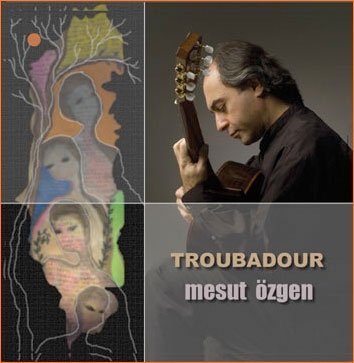


Mesut Özgen — Troubadour
Release date : Aug. 04, 2004
Label : Golden Horn Productions, Inc. / Golden Horn Records
Acoustic Guitar
Guitar Review
Classical Guitar
Soundboard
This is one of Carlo Domeniconi’s most successful works based on Turkish folk music. The theme employed is a famous folk song written by Asik Veysel (1894-1973), an influential Turkish folk musician. Domeniconi’s variations reflect the quasi-improvisatory character of this kind of music very well, especially in the final section of the piece. Asik Veysel is one of the most renowned representatives of the “asik” tradition in the 20th century, which dates back to the 15th century in Anatolia. The Asik (a kind of troubadour), singing poetry (mostly their own) and playing the saz , has become the voice of common people, expressing their relationship with their land; their loves, inner conflicts, and expectations–generally depicting all aspects of rural life. Veysel’s poetry is metrical, using predominantly 8- and 11-syllable meters. His melodic patterns, trills, and particular emphases result in a unique musical character. Mesut Özgen
The Gigue is part of a larger suite, neo-baroque in style [commissioned by luthier Thomas Humphrey and written for Benjamin Verdery]. My system of harmony is to use older background harmonic motions and then fill them in with added notes, which either spice the harmony, or all right replace them. This is how music gradually progressed through Brahms and Wagner, and later Stravinsky. Besides the “spiked” harmonies, rhythmic substitutes abound, much more so than in the works of Bach, they are more like raga substitutes. Anthony Newman
Although there is a brilliant coda, Gigue basically is a binary work, with the second half twice as long as the first half. The piece is written in Newman’s system of substitute harmonies, and features series of short rhythmic cells that when put together give the effect of a Hindu raga (certain material recurs out of order in the second section). Benjamin Verdery
by Johann Kaspar Mertz (1806-1856)
Although a large part of Mertz’s compositional output comprises works based on operatic airs, Fantaisie Hongroise (Hungarian Fantasy) from 3 Morceaux is one of his original works, which, together with Bardenlänge (Bard Sounds) op.13, reflects the renewed interest in troubadour tradition in the early part of the nineteenth century. The Fantasy begins with a series of short sections in different moods and tempos from majestic, passionate, brilliant to sad, melancholic, and ends with a Hungarian gypsy dance-like finale. Because Mertz used an eight-string guitar, I had to transpose several bass notes an octave higher to fit them into the range of my six-string guitar. Mesut Özgen
Bustamante’s Misionera in the style of polca Litoraleña (Paraguaya) is a typical example of música popular, which refers traditionally to music of the people, including folk and traditional music as well as urban music. This solo guitar arrangement from the piano, voice, and guitar version by Argentine guitarist and composer Jorge Morel reflects Morel’s excellent idiomatic writing for guitar. Mesut Özgen
“Misionera” refers to a female from the district of Misiones (where Augustin Barrios was born) in southern Paraguay/northern Argentina. It is a standard work for Paraguayan harpists. Jorge Morel’s arrangement in a minor is based on an earlier arrangement by his teacher, Pablo Escobar, a Paraguayan classical guitarist who lived in Buenos Aires and founded a music conservatory. Rico Stover